runoff to roots Program
Green Stormwater Infrastructure (GSI)
Green stormwater infrastructure is infrastructure designed to manage rainfall by infiltrating water where it falls, rather than routing runoff long distances to centralized locations such as detention ponds, arroyos, or the Santa Fe River. GSI filters stormwater pollutants, reduces flood impacts, and promotes passive irrigation for plant growth and ecosystem resilience. GSI can be implemented at various scales, ranging from simple residential landscaping and roadside rain gardens, to large infiltration galleries within public parks.
The City of Santa Fe encourages the use of GSI to treat runoff as a resource, infiltrating rainfall as close to the source as possible. Our Green Stormwater Infrastructure Storymap shows where existing GSI is located throughout the City, primarily along roadways and in City parks.
The City hopes to expand the use of GSI with its new Runoff to Roots program, which will support neighborhoods that wish to install rain gardens in public spaces such as city parks, open spaces, and street right-of-way (ROW). These rain gardens can collect and infiltrate stormwater runoff from impervious areas into a basin, which can improve water quality and attenuate peak runoff volumes.
The City completed a study of locations for GSI along Alameda St. in 2013 (the Alameda Rain Garden Program), in attempts to reduce the amount of roadway flooding in strategic locations. This study identified 30 potential sites that could be funded for construction through this program, if there is neighborhood interest and a maintenance MOU in place.

Areas Suitable for GSI
Roadways can be ideal locations for GSI because they already collect and transport stormwater runoff. A simple cut in the curb can be made to direct flow into a basin next to the roadway that is designed to filter pollutants and infiltrate the runoff, instead of having it discharge directly into an arroyo.
Some roadways and public spaces are more suitable for creating a rain garden than others. Suitable locations for public ROW rain gardens include: along roadways, chicanes, bump outs, or drainage basins. Important factors to consider when siting a rain garden are:
-
Topology and Drainage: How does water flow across this site? How is water currently channeled and drained across the land? Is there a natural low- point where water naturally concentrates and settles? What is the shape and slope of the road?
-
Existing Infrastructure: Is there an existing curb and gutter on the road? What other existing infrastructure (e.g., sidewalks, utility lines, trees) is present and is there a potential conflict with the proposed GSI installation? If the rain garden floods during a large storm, what infrastructure may be affected? Are there neighboring properties at risk?
-
Soil and Permeability: Is the site permeable? What soil currently exists there? Does stormwater currently infiltrate or stay puddled?
-
Site Dimensions and Capacity: What area is available for GSI implementation, and how will this impact the design capacity? Is the site large enough to effectively manage stormwater? Are there other factors, such as proximity to a sidewalk, that should be considered?
-
Site Ownership: Who owns the property where the rain garden will be built? If on private property, does the owner commit to maintenance?
-
Appropriate Plants for Site: Depending on how much water the rain garden will receive, what types of plants are appropriate for the site? Are trees suitable, based on public line of sight requirements, overhead utilities, etc.? In smaller areas, select trees that are more columnar or conical to avoid branching into sidewalks or roadways
-
Planting Site: Ideal locations provide at least 1,000 cubic feet (ft³) of soil volume per tree. However, smaller areas can also support healthy tree growth if they feature adequate drainage and direct access to stormwater runoff.
How to Participate in Runoff to Roots Program - The Permit Process
Rain gardens can be installed in both public and private rights-of-way (ROW), to capture stormwater runoff from streets. If the ROW is public, nearby property owners can apply for the Runoff to Roots program for City assistance with installation. Follow the steps below. If the ROW is private, the standard designs for these eddy rain gardens are provided below for the property owner to install.
Public Property GSI
.png)
Private Property GSI
If the City cannot take on the proposed rain garden at this time, or it is on private property, the neighborhood can still go through the process of constructing a rain garden and applying for a curb cut permit through the Streets Division, with their own funding. The above conditions must still be met to proceed with a City-approved rain garden. Follow instructions in the section below for how to build your rain garden!
If the ROW is on public property and the following criteria are met, the City will proceed with building an eddy rain garden that the neighborhood will maintain.
-
Street must be crowned rather than concave.
-
Potential rain garden location must have a curb/gutter slope <3%.
-
Sidewalk elevations must be equal to or higher than the top of curb.
-
The width between the back of curb and sidewalk must be greater than or equal to 3 feet.
-
Non-irrigated trees require Parks and Open Space Division Director approval.
Cutting the curb will be the final element to the rain garden installation. Moving the curb cut downslope should be considered if the City deems that stormwater pooling elevation will exceed the basin edges based on the proposed curb cut location.
How to Build a Rain Garden - Eddy Design
How to Build a Rain Garden - Eddy Design
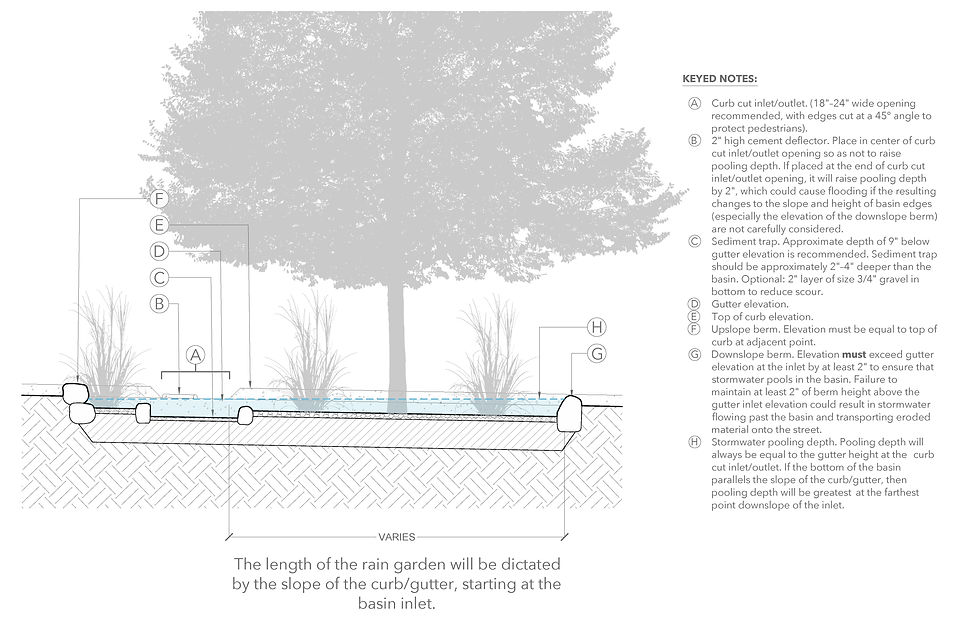
Many streets include a right-of-way (ROW) buffer between the road and sidewalk. The buffer can vary in width, might include subsurface and overhead utilities, and will likely have traffic signs/warnings. In some cases, the buffer could serve as a favorable location for improving urban tree canopy by capturing stormwater runoff as passive irrigation for a rain garden. A simple rain garden to create in the ROW is a basin that eddies (i.e. stormwater enters a basin through an inlet created by a curb cut, fills the basin until the water pools, and circles back out at the same curb cut entrance point, which also serves as the outlet). The inlet and the outlet existing at the same location causes stormwater to eddy in this type of rain garden, which is beneficial for promoting infiltration and preventing erosive currents.
Please follow construction guidelines below, created by the RainCatcher and Southwest Urban Hydrology. Specifications can be downloaded here: Eddy Rain Garden Design Specifications.


Calculating the relationship between existing curb/gutter slope and maximum rain garden length downslope from the curb cut inlet/outlet: The estimated length leaves approximately 2-inches of berm height above the maximum pooling depth (assumes standard 6-inch high curb).
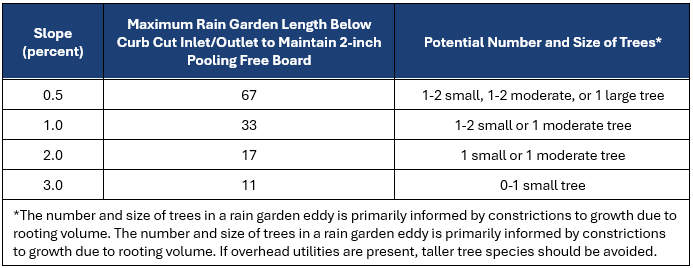
The method for calculating the maximum length of a rain garden from the inlet to the downslope berm is:
(Curb height in inches - Desired berm height above max. pooling depth in inches / curb slope) x (1 ft/12 inches) x 100
For example, a 6-inch tall curb with a 2% slope allows for a ~17 ft rain garden with 2-inch of free board.
(6 inch - 2 inch / 2%) x (1 ft/12 inch) x 100 = 16.7 ft of basin length from inlet to downslope berm
Plant Information / Species Suitability
Below are pictures of plants that might do well in rain garden eddies based on regional experimentation at other Green Stormwater Infrastructure sites within the City of Santa Fe. Download a list of these plants here: Rain Garden Recommended Plant List. More plants can be found on the City's Municipal Tree Board webpage.
Grasses, Shrubs, and Small Trees


Blue grama (Bouteloua gracilis) and Buffalo grass (Bouteloua dactyloides)
Three-leaf sumac (Rhus trilobata)


Aklali sacaton (Sporobolus airoides)
Indigo bush (Amorpha fruticosa)


Desert willow (Chilopsis linearis)
New Mexico privet (Forestiera Neomexicana)


Curl leaf mahogany (Cercocarpus ledifolius)
Little bluestem (Schizachyrium scoparium)
Small and Moderate Trees
2_JPG.jpg)
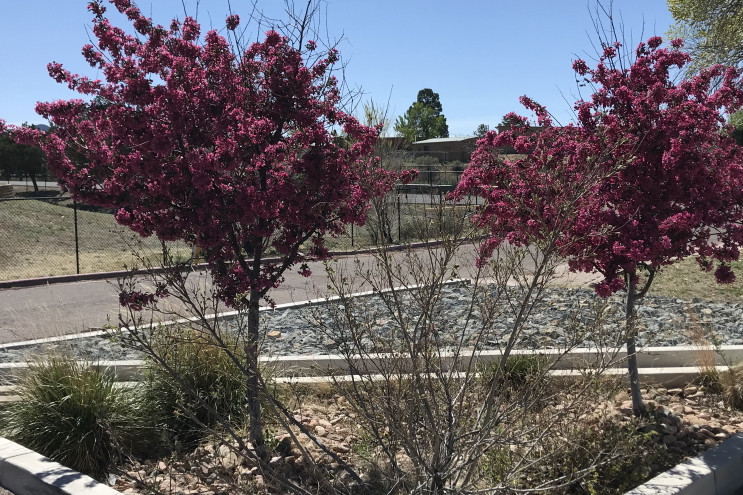
Frontier Elm (Ulums minor x Ulmus parvifolia 'Frontier')

Prairifire Crabapple (Malus 'Prairifire')

Chinkapin Oak (Quercus muehlenbergii)
Imperial honeylocust (Gleditsia triacanthos 'Imperial' or 'Impocole')
Large Trees

Urbanite Ash (Fraxinus pennsylvannica 'Urbanite')

Shademaster Honeylocust (Gleditsia triacanthos 'Shademaster')

Lacebark Elm (Ulmus parvifolia)
Examples of Eddy Rain Garden Construction



Typical roadside right-of-way (ROW) without GSI with white pin flags identifying a utility location request.
Initial excavation of the rain garden eddy after the utility locate is clear.
Armoring of interior basin edges to prevent erosion below the sidewalk and the installation of a railing to alert pedestrians. Arrows show how stormwater will enter and leave the basin.
Interior of rain garden eddy prior to soil amendments, sediment trap, and planting. Blue dotted line shows maximum depth of pooling water (i.e. equal to gutter elevation at inlet).
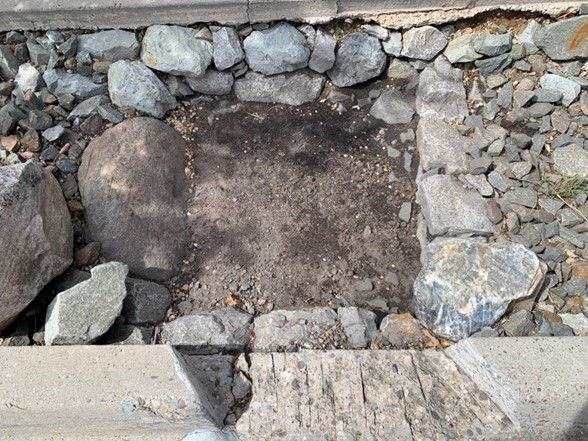
The sediment trap is slightly deeper than the basin at the inlet to help pool and capture soil and trash. The trap should be maintained regularly.
Blue grama and buffalo grass emerging from under a cobble mulch in basin bottom.